Every query, limited to its business
Records, appointments, requests, knowledge and recordings are always queried with the business identified. A query without a business returns no data.
On this page
How the Gestión Smart AI voice agent works
For technical and data protection leads: how each call is assigned to its business, how data is isolated, how long the agent takes to respond and what happens if the service fails. Speech recognition runs on our own GPUs.
2 s: natural pause 4 s: excessive delay
Without interrupting calls
Speech recognition: on our own GPUs
Last updated:
The system first identifies the number that was called, not who is calling. That number belongs to a specific business and a specific agent, and it determines everything else: which voice answers, which calendar is checked and which data can be accessed.
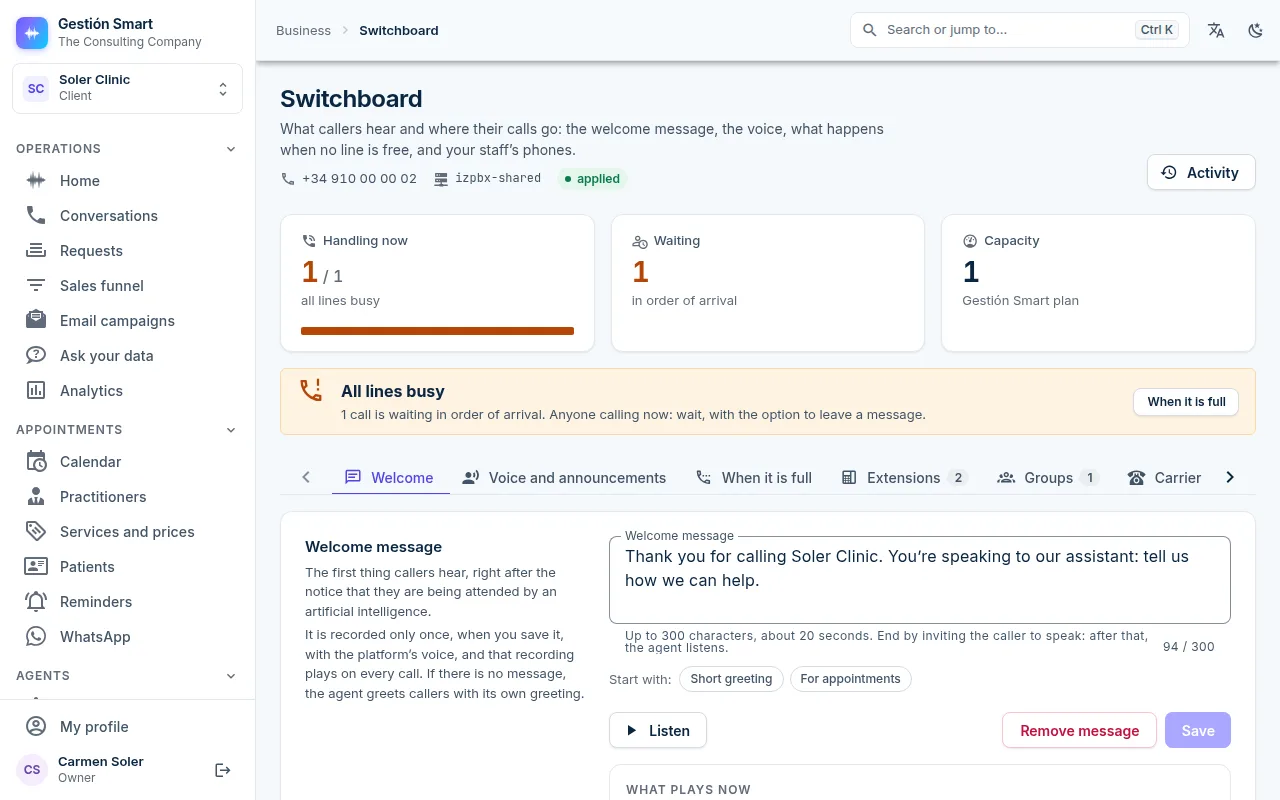
The panel shows the calls in progress, those waiting and what callers hear, including when all lines are busy.
The platform serves many businesses at once and none of them can access another’s data. Every piece of data is linked to its business, and that link goes with it wherever it is used.
Records, appointments, requests, knowledge and recordings are always queried with the business identified. A query without a business returns no data.
The access keys to your system and your payment gateway belong to you, are stored encrypted and are never used to handle another business’s calls.
Owner, editor, read only, billing and the platform team. Every change is logged with its author and time, as is every playback of a recording.
We work to a target of 1.2 seconds from when the customer finishes speaking to when the agent starts to respond.
The panel records the time of each turn, so the target is checked call by call. Up to 2 seconds is perceived as a natural pause; above 4, the turn is flagged so that the cause can be analysed.
Each turn is logged with what was said, how long the agent took to respond and what it looked up. Transcription is done on GPUs in our own infrastructure: the audio is not sent to third parties.
During the conversation, the agent checks your calendar and the systems you have connected. Each look-up has a maximum time, because on the other end there is a customer waiting for an answer.
Finding a slot, opening a request or looking up an invoice are different operations and cannot take the same time. Each one has a margin; if it runs out, the agent says so and offers to call back or to transfer the call to a person.
Look-ups that exceed their margin are recorded in the turn, with their duration.
If the data resides in your system (an invoice, a debt, the status of a repair or a contract), it is looked up at that moment. No copy that could go out of date is stored.
For each piece of data, you decide what the agent does: it states it, states it only if asked, confirms only the last four digits, uses it solely to identify the account holder, or never takes it out of your system. You can also require callers to identify themselves before they are given any data.
An agent that improvises a free time or a price creates problems for your business. That is why everything it can offer is limited to the actual information in your calendar and your systems.
Times come from your calendar at that very moment, with the length of the service and the corresponding professional. If nothing is available, it says so and suggests another date.
It answers with the information you have provided and the information your systems return. If it does not have the answer, it says so and opens a request with its reference.
It checks who is available at that moment and transfers the call to them. If nobody is available, it takes down the name, the confirmed phone number and the reason as a callback request.
In the panel’s natural-language queries, the model interprets the question, but the calculation is done by the server on your data. The model does not generate any figures.
Before an agent takes its first call, you must specify which phone number calls are forwarded to if the service is unavailable. Without that number, the agent cannot be published.
It can be the mobile of the person on duty, the reception landline or your usual switchboard. In the worst case, the call rings where it used to ring before.
Transcribing what the customer says and synthesising the agent’s voice run on our own servers with GPUs. To update or repair a server, it is taken out of the call rotation: it stops receiving new calls, completes the ones it has in progress and only then shuts down.
Voice cloning requires between 10 and 12 seconds of recording and the express consent of the person.
Speech recognition
Speech recognition runs on GPUs in our own infrastructure. The audio is not sent to third-party services.
Current limitations: the agent speaks six languages (Spanish, English, German, French, Italian and Portuguese); Catalan, Basque and Galician are not available yet and have no date. Coming soon: synchronisation with calendars from other providers. In development, no date: logistics and delivery.
The target is 1.2 seconds from when the customer finishes speaking to when the agent starts to respond. The panel records the time of each turn, so it can be checked call by call: up to 2 seconds is perceived as a natural pause and, above 4, the turn is flagged so that the cause can be analysed.
The call is forwarded to the backup number. That number is mandatory: without a forwarding number, Gestión Smart does not allow an agent to be published.
The system first identifies the number that was called, not who is calling. That number belongs to a specific business and a specific agent, and the assignment is checked against the database. In addition, every query for records, appointments, requests or recordings includes the business: a query without a business returns no data.
Yes. A server that is taken out of service stops receiving new calls before it shuts down and completes the ones it has in progress.
Not if the data resides in the business’s system. Invoices, debts, the status of a repair or a contract are looked up at the time of the call, and no copy that could go out of date is kept. For each piece of data, the business decides what the agent can do: state it, state it only if asked, confirm only the last four digits, use it solely to identify the account holder, or never take it out of its system.
Spanish, English, German, French, Italian and Portuguese. Each business chooses which language the call starts in, and the caller can ask for another one mid-conversation: it is still the same call, with what they have already said and with their appointments. The AI notice plays in the business’s language, and the panel is available in those same six languages. Catalan, Basque and Galician are not available yet and have no date: they must first pass the same tests with real calls.
On our own servers with GPUs. Speech recognition is performed on that infrastructure, so the audio is not sent to third-party services. When a server needs updating, it stops receiving new calls, completes the ones it has in progress and only then shuts down.
We show you the panel, the transcript with the response times and how the agent connects to your systems. If something is not available, we tell you clearly.